
Sysnav Healthcare was delighted to participate in the 30th Annual International Congress of the World Muscle Society, in Vienna, Austria, from October 7 to 11, 2025.
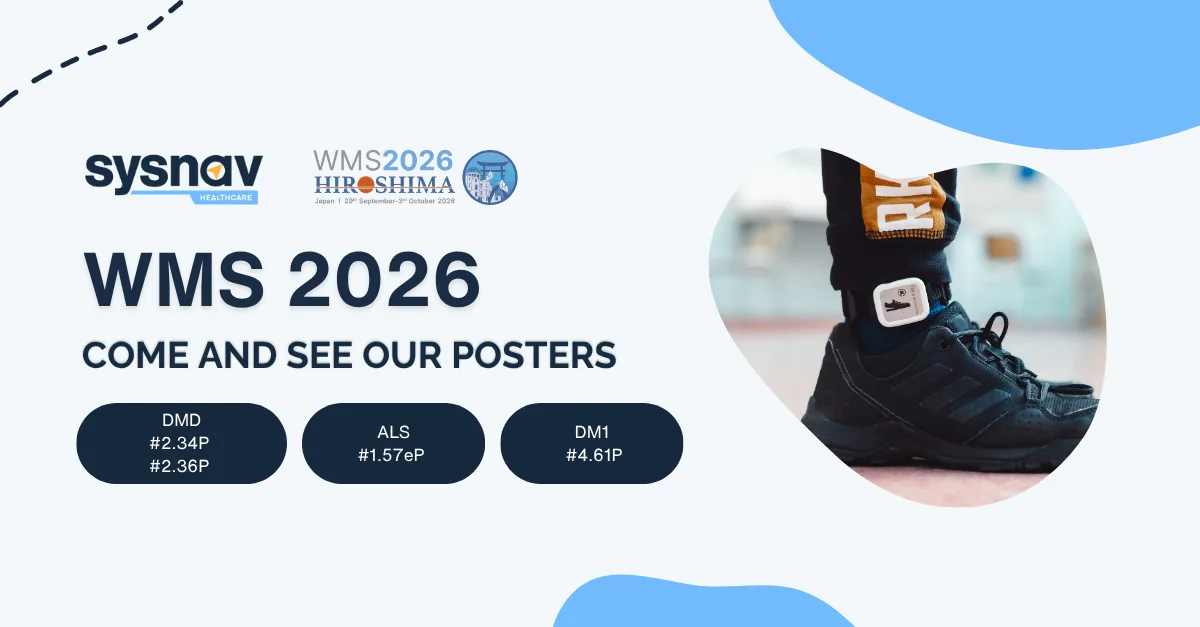
Our team presented four posters demonstrating how digital biomarkers and wearable technology can objectively track disease progression across a range of neuromuscular disorders:
- DMD: two posters in collaboration with Prof. Laurent Servais’ team from Oxford University and CHR Citadelle in Liège, presenting longitudinal results in patients above and below 4 years old. Download them here and here.
- FSHD: a poster in collaboration with Prof. John Vissing’s team from Rigshospitalet, on the analytical validation of Syde®’s measurements of upper- and lower-limb movements. Download it here.
- CMT and DM1: a poster in collaboration with Prof. Laurent Servais’ team, on the feasibility of using a wearable digital health technology sensor to assess ambulation in this patient population. Download it here.
We are grateful to the World Muscle Society for bringing together the global neuromuscular research community and facilitating this event.
Witnessing the latest advances in research and emerging therapies has energized the Sysnav team, inspiring us to advance the use of digital biomarkers in neuromuscular research.