

In July 2023, the European Medicines Agency (EMA) granted qualification to SV95C (Stride Velocity 95th Centile) as a primary endpoint for clinical trials in ambulatory patients with Duchenne Muscular Dystrophy (DMD) aged 4 and above[1]. This built on a first EMA qualification obtained in 2019, when SV95C was qualified as a secondary endpoint in DMD trials for patients aged 5 and above. This was the first time a digitally derived outcome measure had received a formal regulatory qualification as a primary endpoint in clinical trials for any therapeutic indication, setting a significant precedent for the field of digital medicine.
SV95C, developed and validated by Sysnav Healthcare and its partners, represents the velocity of the 5% most rapid strides taken by a patient during everyday living, captured continuously by an ankle-worn fit-for-purpose wearable. Compared to traditional assessments such as the 6-Minute Walk Test (6MWT) or the North Star Ambulatory Assessment (NSAA), SV95C demonstrated earlier sensitivity to disease progression, detecting statistically significant change at 3 months versus 9 months for conventional measures[2].
Reaching this qualification required meeting a rigorous and multidimensional evidentiary standard. Analytical validation, clinical validation, hardware performance, data quality, patient compliance, and real-world operational deployment all had to be addressed systematically, each representing a genuine scientific and operational challenge. Each of these conditions is examined below, revealing why qualifying a digital endpoint is a far more complex process than it might initially appear.
1. Being Representative of the Patient’s Real Life
A fundamental requirement for SV95C to be meaningful as a clinical endpoint is to measure the patient in their daily environment encompassing the full range of life situations: moments when they are rushing, feeling fatigued, or overcoming the obstacles of daily life. Because walking activity naturally varies from one day to the next, a single day of recording is not sufficient to obtain a stable and reliable estimate of a patient’s top ambulatory performance.
An intra-patient variability analysis was conducted on 28 patients with DMD who wore the device for a minimum of 1,800 hours. This analysis showed that variability in SV95C decreases significantly as recording duration increases, with an average variability of 6.38% for 50-hour periods and 4.41% for 180-hour periods. Critically, below 50 hours of recording, variability increased exponentially, which informed the definition of the 50-hour threshold as the absolute minimum for an acceptable recording period.

Without continuous long-term monitoring, temporary low-activity days can severely skew clinical variables and distort the true picture of a patient’s real life.
Equally important is how this data is collected. SV95C is derived from fully passive monitoring. Ease of use is paramount to ensure long-term compliance of patients wearing their device without disturbing their daily routine. Data collection with Sysnav’s devices is entirely automatic and continuous to minimize patient burden.
This is particularly meaningful in DMD, where the patient population is predominantly children. Adding measurement burden to a child’s daily life, whether through active tasks, frequent clinic visits, or complex device interactions, is both ethically and practically undesirable. Fully passive monitoring ensures that trial participation does not meaningfully disrupt a child’s routine, which in turn supports better compliance and more naturalistic data collection.
2. Using a Valid and Suitable Wearable Device
SV95C relies on the accurate measurement of the distribution of velocities of individual strides. That is why SV95C, as defined in the EMA qualification opinions as a secondary and then primary endpoint, is measured at the ankle. The acceleration and angular velocity patterns created by strides are most detectable at this placement; for instance, wrist-worn step counters have been shown to be less accurate than ankle-worn ones[3].
Analytical validation in the population of interest is a fundamental requirement to verify this accuracy. The DHT(Digital Health Technology) needs to capture not just walking in a straight line, but the full complexity of how patients move in their daily lives. Real life involves stairs, changes in pace, the occasional run, the use of different walking aids, scooters, bikes, etc. If a wearable device cannot handle this diversity of movement, the data it produces will be an incomplete and potentially misleading representation of a patient’s true functional ability. In the qualification dossier, evidence was presented across multiple layers.
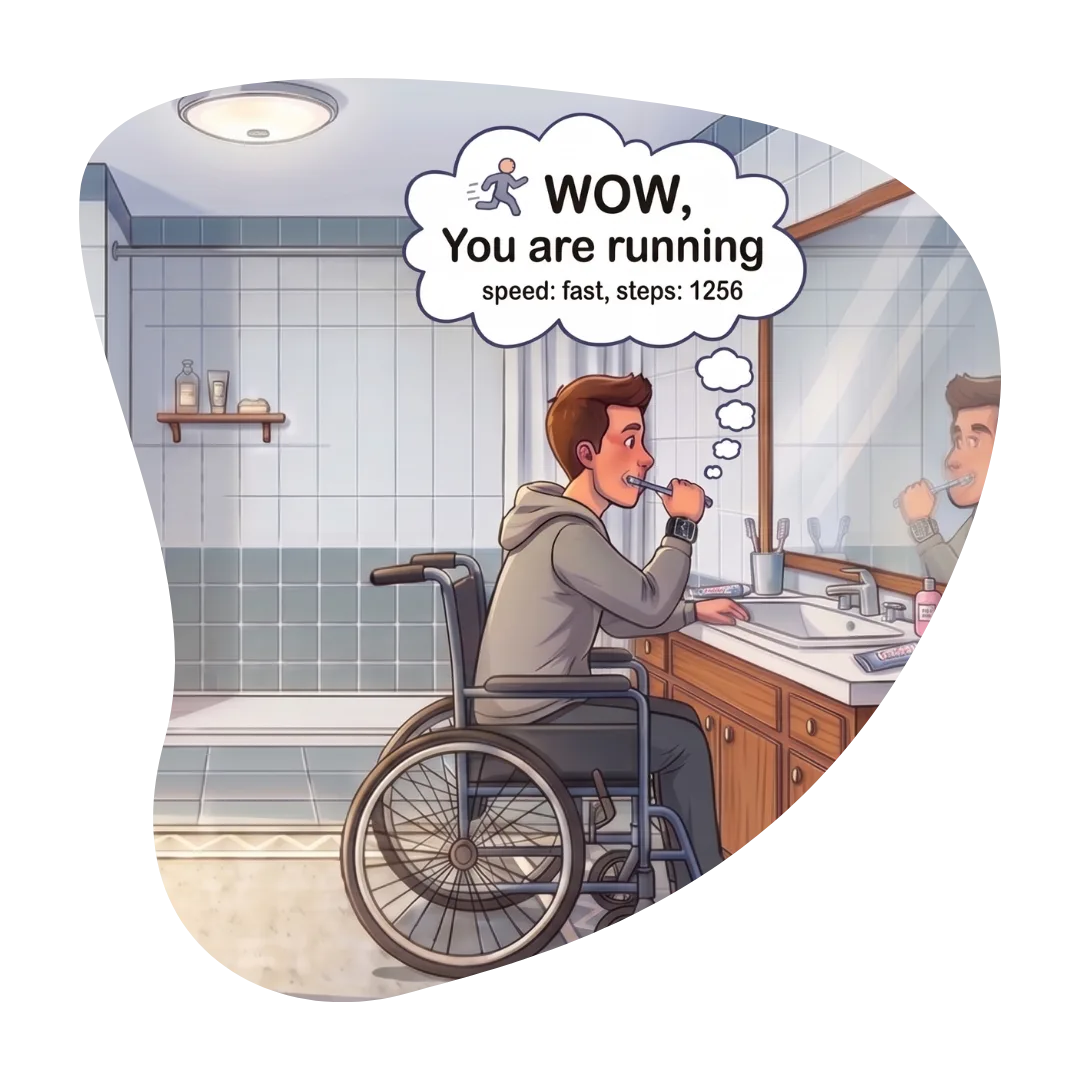
Inaccurate device placement or validation can produce misleading data, such as detecting high-speed running while performing stationary daily movements.
First, Sysnav’s wearable sensors and stride reconstruction algorithms were validated in healthy controls across a range of controlled walking situations, including different trajectories and gait speeds, in a motion capture room equipped with high-precision cameras used as a reference standard. In this setting, they detected 98.7% of strides, with a mean difference in stride speed versus the motion capture system of just 0.01 cm/s.[4] Stride reconstruction accuracy was not impacted by the way participants walked, and the system delivered an accurate speed measurement for every single stride, not just an average over a walking episode.
Critically, the algorithm was also validated in the intended patient population, both in controlled and uncontrolled environments. This distinction matters because DMD patients do not walk like healthy controls. Their gait may be slower, asymmetric, or altered by muscle weakness, with some patients relying on walking aids. The algorithm was specifically designed and validated to function accurately regardless of these variations, achieving greater than 99% stride detection precision and greater than 97% recall across the full spectrum of ambulatory presentations seen in DMD patients.
Together, these properties establish that, when based on data from Sysnav’s validated sensors, what SV95C measures is a true and precise reflection of a patient’s ambulatory performance. This is a fundamental prerequisite for any endpoint seeking regulatory qualification.
3. Suited To Deployment in Clinical Trials
Scientific validation alone is not sufficient for a digital endpoint to function in a clinical trial. The technology must also be deployable, monitorable, and controllable at scale. Even the most rigorously validated endpoint will fail in a clinical trial if the device is difficult to use, compliance is not monitored, or data quality cannot be guaranteed. Operational deployment is therefore a critical and often underestimated component of what makes SV95C qualifiable.

Even validated devices fail if they are cumbersome to use, leading to poor patient compliance and abandoned hardware.
Firstly, the Syde device is designed to be usable without any technical expertise by the patient, caregiver, or clinical site. The sensor kit is plug-and-play, comes with multilingual patient instructions, and requires no technical infrastructure at the site level.
Secondly, patient compliance is monitored remotely and in real time throughout the study. Each study is assigned a dedicated study manager, who serves as the single point of contact between the clinical sites, sponsors, and the Sysnav Healthcare team. The study manager actively monitors individual patient compliance and proactively informs the sites when wear time falls below acceptable thresholds. This continuous oversight is what has enabled Sysnav Healthcare to consistently achieve greater than 90% compliance across trials.

Clinical trial tools must be simple and plug-and-play; requiring complex setup processes or high technical effort creates unnecessary burden and friction for users.
Thirdly, data quality control is embedded throughout the process in a GCP-compliant framework, ensuring that the data collected is not only complete but also reliable and audit-ready for regulatory submission.
This level of operational rigor is a prerequisite for the data generated during a clinical trial to be considered acceptable by regulatory bodies as evidence of treatment efficacy.
Conclusion
The EMA qualification of SV95C as a primary endpoint was the result of years of rigorous, multidimensional scientific work. Each of the conditions described in this article had to be met simultaneously, and each one presented its own set of challenges. It is precisely this depth of evidence that gives SV95C its scientific and regulatory credibility.
Beyond DMD, this qualification sets an important precedent for the broader field of digital medicine. It shows that regulatory agencies are willing to accept digitally derived outcome measures as primary evidence of treatment efficacy, provided the evidentiary standard is met. This opens the door to a new generation of digital endpoints across neuromuscular, neurodegenerative, and other mobility-affecting disorders.
References
European Medicines Agency. Opinions and letters of support on the qualification of novel methodologies for medicine development [Internet]. Amsterdam: European Medicines Agency; [cited 2026 Jul 22]. Available at: https://www.ema.europa.eu/en/human-regulatory-overview/research-development/scientific-advice-protocol-assistance/opinions-letters-support-qualification-novel-methodologies-medicine-development
European Medicines Agency, Committee for Medicinal Products for Human Use. Qualification Opinion for Stride velocity 95th centile as primary endpoint in studies in ambulatory Duchenne Muscular Dystrophy studies [Internet]. Amsterdam: European Medicines Agency; 2023 Jul 28 [cited 2026 Jul 22]. Report No.: EMADOC-1700519818-1127132. Available at: https://www.ema.europa.eu/en/documents/scientific-guideline/qualification-opinion-stride-velocity-95th-centile-primary-endpoint-studies-ambulatory-duchenne-muscular-dystrophy-studies_en.pdf